WaveLight Plus vs Femto LASIK: Key Differences for Indian Patients
MBBS, MS (Ophthalmology), Fellowship in Phaco & Refractive Surgery · The Healing Touch Super Speciality Eye Care, New Delhi — Vikaspuri · Janakpuri
If you’ve been offered both WaveLight Plus InnovEyes and Femto LASIK for your spectacle removal surgery, you’re probably wondering which is right for you. Both are advanced, bladeless laser procedures, but the real difference lies in how each treatment is planned and personalised to your eyes.
In this guide, we break down the technical and practical distinctions between WaveLight Plus and standard Femto LASIK as offered in India. We’ll focus on diagnostics, treatment planning, ablation profiles, suitability, and what to expect in terms of pricing and follow-up care. By the end, you’ll be better equipped for your consultation — and know which questions to ask about your own eyes.
Understanding the Femto Flap: What Both Procedures Share
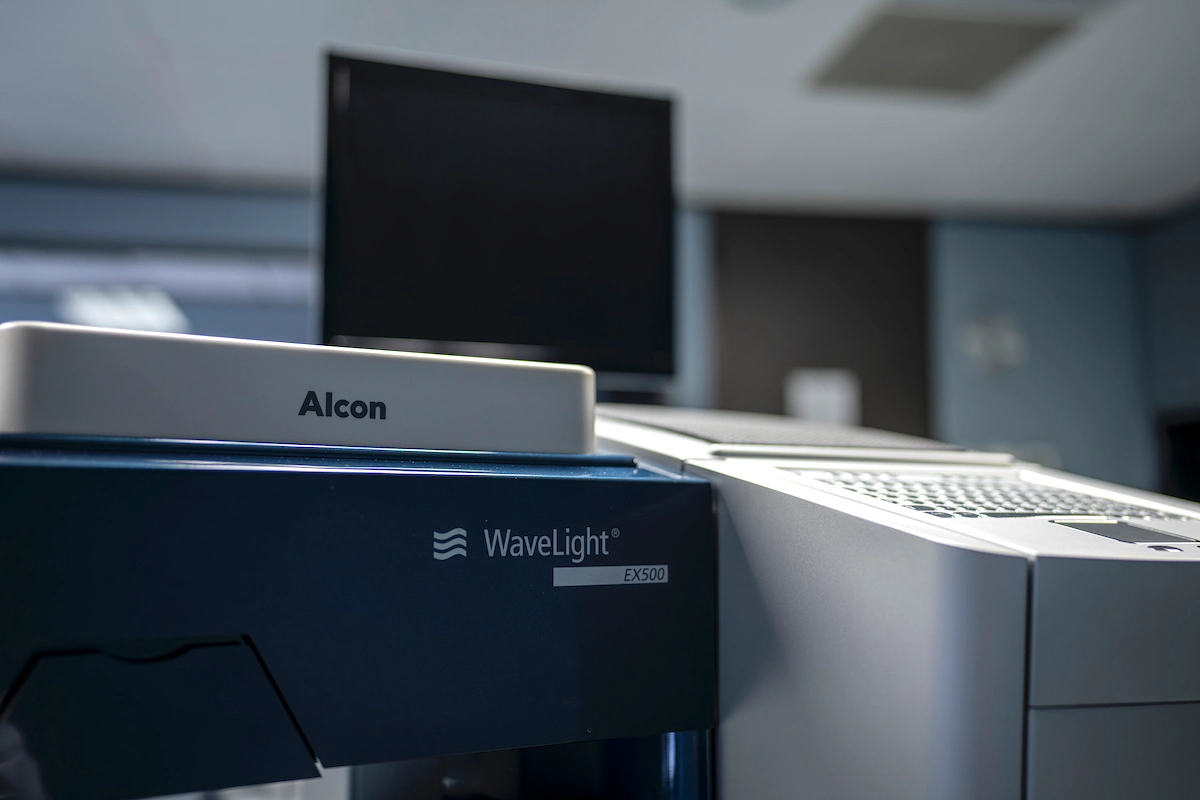
Both WaveLight Plus InnovEyes and Femto LASIK are called "bladeless LASIK" because they use a femtosecond laser to create the thin corneal flap — not a manual blade. This flap is gently lifted to allow reshaping of the underlying cornea with an excimer laser.
This method offers:
- Greater precision and uniformity in flap creation
- Lower risk of certain flap-related complications compared to older blade microkeratomes
- Faster healing and comfort for many patients
So, when comparing femto LASIK vs InnovEyes, remember: both share the same modern, gentle flap creation. The difference comes next — in how your treatment is actually planned and the level of personalisation possible. If you want to understand more about how these flaps work and why they matter, see What is WaveLight Plus InnovEyes?.
| Aspect | Femto LASIK | WaveLight Plus InnovEyes |
|---|---|---|
| Flap Creation | Femtosecond laser (bladeless) | Femtosecond laser (bladeless) |
| Diagnostics | Corneal mapping, basic aberrometry, prescription check | Advanced Eye Mapping: high-res corneal, lens and whole-eye scans, ray-tracing |
| Treatment Planning | Based on spectacle number and corneal shape | Digital Eye Twin model, considers unique whole-eye optics |
| Ablation Profile | Standard or wavefront-optimised | Ray-traced, highly personalised |
| Suitability | Most standard cases with healthy corneas | For patients needing advanced personalisation or with complex optics |
| Potential Vision Quality | Corrects power reliably; less customisation for higher-order aberrations | Targets higher-order aberrations; may improve contrast/night vision for some |
| Price (per eye, all-inclusive) | ₹35,000–₹50,000 (varies by centre) | ₹49,999 |
| Pre-Surgery Assessment | Standard evaluation (may not include advanced mapping) | Free Advanced Eye Mapping session included |
| Follow-Up Care | Typically 6–12 months included | 12 months included |
| Financing Options | Available at select centres | No-cost EMI from ₹4,167/month |
Personalisation in Treatment Planning: Spectacle Number vs Digital Eye Twin
Traditional Femto LASIK typically plans your laser ablation based on your spectacle prescription and some basic corneal measurements. This method has helped lakhs of Indian patients achieve spectacle independence, but it doesn’t always account for the unique ways light travels through every part of your eye.
WaveLight Plus InnovEyes adds a major diagnostic and planning layer: it uses "Advanced Eye Mapping" with ray-tracing technology. Several non-contact scans measure not just your corneal shape and thickness, but also how light bends inside your entire optical system — including the lens and internal aberrations. This data is used to create your "Digital Eye Twin", a sophisticated virtual model of your own eye’s optics.
This means the ablation profile for WaveLight Plus is based on far more than your spectacle number. It considers subtle vision issues (like higher-order aberrations) that standard planning might miss. For some patients, this can mean improved clarity or night vision — but outcomes always depend on your unique anatomy.
Diagnostics and Assessment: What to Expect Before Surgery
Every LASIK candidacy assessment should start with a thorough eye examination, including corneal thickness, shape, prescription stability, and dry eye status. Both Femto LASIK and WaveLight Plus require these checks, but the depth of diagnostics differs.
With WaveLight Plus InnovEyes, your evaluation includes a free Advanced Eye Mapping session at Centre for Lasik. This process involves:
- Multiple high-resolution scans (topography, tomography, aberrometry)
- Detailed mapping of both the cornea and internal optics
- Assessment of subtle distortions that may affect vision quality
Femto LASIK candidates also undergo corneal mapping and prescription checks, but may not receive the same breadth of optical measurements unless specifically requested. If your vision issues go beyond a routine spectacle number — for example, if you struggle with night glare, halos, or have a complex prescription — this extra mapping may help your surgeon customise your plan. You can read more about eligibility and how assessments work here.
Ablation Profiles: Standard vs Ray-Traced Correction
The technique used to reshape your cornea (ablation profile) determines how your spectacle power is corrected. Femto LASIK generally uses standard or wavefront-optimised profiles, based on average eye models and your glasses prescription. These have a proven track record and are suitable for many patients.
WaveLight Plus InnovEyes uses a ray-tracing-guided ablation profile, relying on the Digital Eye Twin created during diagnostics. This allows the laser to address not just spherical and cylindrical power, but also individual higher-order optical distortions present in your unique eye. For some patients, this can translate to improved contrast, reduced glare, or sharper night vision.
However, not every eye has significant higher-order aberrations, and not every patient may notice a dramatic difference. The sophistication of the profile is most beneficial when your clinical assessment shows potential for improvement beyond standard correction. This is why a detailed mapping session is key to determining suitability.
Suitability: Who May Benefit from Each Option?
The right procedure for you depends on multiple personal factors — not just your spectacle number. Both Femto LASIK and WaveLight Plus InnovEyes require:
- Sufficient corneal thickness
- Stable prescription for at least a year
- Healthy corneal shape and eye surface
- Age (usually 18+)
Femto LASIK remains a reliable, cost-effective solution for many straightforward cases. It’s appropriate for patients with standard prescriptions and healthy eyes, and is well accepted for general professional requirements.
WaveLight Plus InnovEyes may be considered if:
- You have complex or high prescriptions
- You experience visual quality issues (e.g., glare, halos, night vision problems)
- You want the most detailed personalisation currently available
- You’re preparing for a career with demanding visual standards (aviation, defence — but always check the latest rules)
Ultimately, only a comprehensive eye examination and surgeon assessment will determine which is best for you. For more guidance, see How to Choose Between LASIK, SMILE, SILK & WaveLight Plus.
Cost Comparison and What’s Included in India
Pricing is one of the key considerations for many Indian patients. At Centre for Lasik, WaveLight Plus InnovEyes is offered at ₹49,999 per eye (₹99,998 for both eyes), all-inclusive. This covers:
- Free Advanced Eye Mapping
- Surgery with ray-tracing guided ablation
- All medications and post-op kits
- 12 months of follow-up visits
- No-cost EMI options starting from ₹4,167/month
Femto LASIK pricing in India can vary widely by centre and technology, but is generally lower than WaveLight Plus. Typical Femto LASIK packages range from ₹35,000–₹50,000 per eye at major centres, depending on diagnostics and aftercare inclusions.
WaveLight Plus InnovEyes costs more mainly because of the advanced diagnostics and the extra personalisation. For some patients, this investment may be justified by potential vision quality improvements, but for many, standard Femto LASIK remains an excellent value. You can see a detailed price breakdown here.
Follow-Up Care and What to Expect After Surgery
Both procedures offer quick recovery times, with most patients returning to daily tasks within a few days. With both Femto LASIK and WaveLight Plus InnovEyes, you’ll have scheduled follow-up visits to monitor healing and vision stability for at least 12 months after surgery.
Common post-operative experiences include mild dryness, light sensitivity, or seeing halos at night for a few weeks. Most side effects resolve with time and recommended eye drops. The advanced mapping in WaveLight Plus may help your surgeon detect and address subtle healing patterns if they arise, but no technology eliminates all risks.
It’s important to attend all follow-ups and report any persistent or unusual symptoms promptly. Your clinical team will guide you through safe recovery, regardless of the technology chosen.
Frequently Asked Questions
Still Deciding Between Femto LASIK and WaveLight Plus?
Get a personalised recommendation with a free Advanced Eye Mapping session. Compare all technologies and choose what’s right for your eyes.
+91-96677 70450Related Reading
What is WaveLight Plus InnovEyes? A Plain-Language Guide
Discover what is WaveLight Plus InnovEyes, how it personalises LASIK using advanced Alcon platform tech, and what Indian patients should know before deciding.
Read more Candidacy & EligibilityAm I Eligible for WaveLight Plus InnovEyes? Full Candidacy Checklist
Find out if you are eligible for WaveLight Plus. Explore key criteria like age, prescription, and cornea health in this comprehensive eligibility guide.
Read more Honest ComparisonsHow to Choose Between LASIK, SMILE, SILK & WaveLight Plus InnovEyes
Learn how to choose laser eye surgery in India. Compare LASIK, SMILE, SILK, and WaveLight Plus with 7 key questions to find your best option.
Read more Honest ComparisonsWaveLight Plus vs Contoura Vision: A Patient-Focused Comparison
Compare WaveLight Plus vs Contoura Vision for LASIK in India. Learn about topography-guided and ray tracing methods, suitability, and pricing.
Read more Honest ComparisonsWaveLight Plus vs SMILE: How Do They Differ for Indian Patients?
Compare WaveLight Plus vs SMILE for vision correction. Discover differences in procedure, recovery time, dry eye risk, costs, and patient suitability.
Read more Honest ComparisonsWaveLight Plus vs LASIK: What Sets Them Apart?
Explore the difference between WaveLight Plus and LASIK. Learn how WaveLight Plus uses advanced eye mapping for personalised treatment. Compare now.
Read more